



By Akintunde Aderonke | Fact Frontier.
Click here to read more about the reporter.
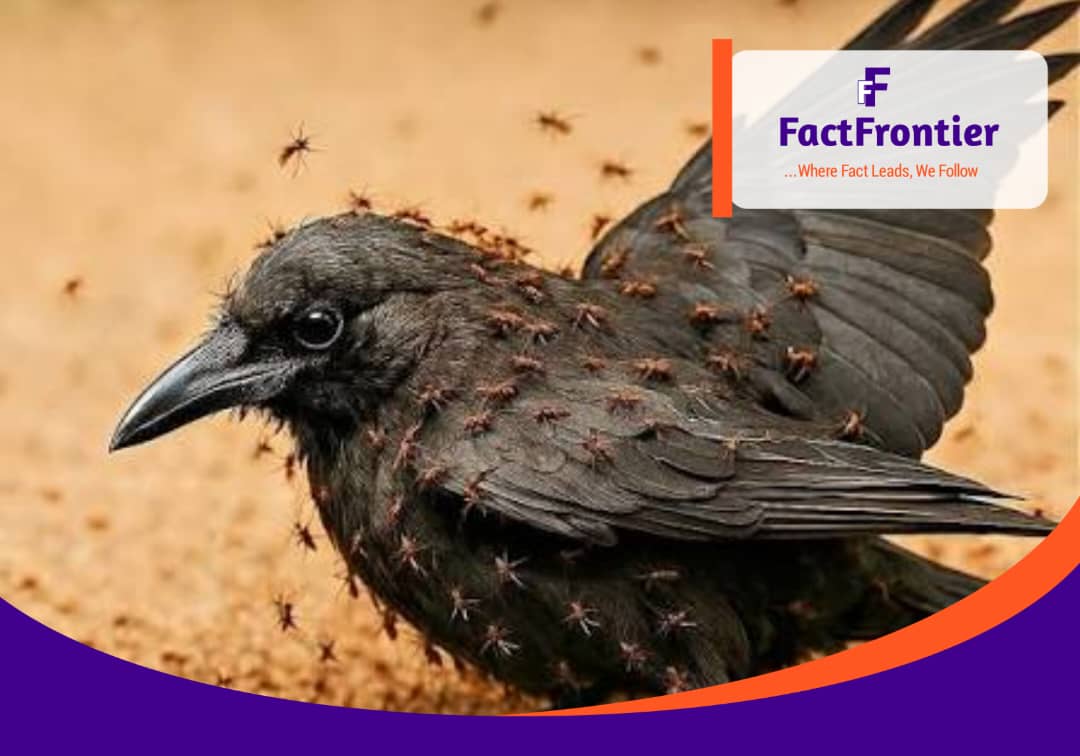
The image is a curious one: a bird, seemingly in a trance, lies with wings outstretched atop a seething anthill, allowing hundreds of insects to crawl through its plumage. Another deliberately plucks ants with its beak and rubs them vigorously under its wings. This is not a scene of distress, but one of deliberate, widespread behavior in the avian world known as “anting.” A popular report claims that sick birds engage in this to be bitten by ants, harnessing their formic acid as a cure. While this narrative is compelling, the full story is a more complex and fascinating blend of observable fact and scientific theory.
The behavior is undeniably real. Ornithologists have documented “anting” for over a century in more than 200 bird species, from common crows and jays to robins and starlings. The behavior manifests in two primary forms. In “active anting,” a bird picks up ants and uses them as living tools, drawing them through its feathers. In “passive anting,” the bird adopts a posture of surrender on an anthill, fluffing its feathers to grant the insects easy access to its skin.
Where the popular report ventures into speculation is with the claim that this is a deliberate medicinal cure sought out by sick birds. The reality is that anting is predominantly a preventative maintenance behavior observed in healthy birds. The connection to formic acid, however, is the central pillar of the most prominent scientific hypothesis.

The Formic Acid Hypothesis: Nature’s Insecticide and Antiseptic?
The birds that engage in anting show a distinct preference for ant species from the family Formicinae, which are equipped with venom sacs containing formic acid. This is no coincidence. Formic acid (HCOOH) is a potent chemical with documented insecticidal, miticidal, and antimicrobial properties. The leading theory, therefore, is that birds are using the ants to administer this chemical to their bodies.
The primary benefit is likely parasite control. The featherwear of a bird is a prime habitat for ectoparasites like lice, mites, and ticks. By allowing formic acid to be sprayed or smeared across their skin and feathers, birds may be effectively fumigating their own bodies. The acid could kill the parasites directly or simply irritate them, making it easier for the bird to dislodge and eat them during subsequent preening. As noted in the comprehensive text, "The Birds of North America," the behavior is widely considered a "maintenance activity," with one of its chief functions being "to reduce ectoparasites."
Furthermore, formic acid could serve as a feather conditioner and antiseptic. The molting process can cause skin irritation, and the acidic environment might help soothe it. It could also inhibit the growth of fungi or bacteria that can degrade the keratin in feathers, which are critical for flight and insulation. In his seminal work, The American Crow and the Common Raven, ornithologist Lawrence Kilham observed anting extensively and noted that it often coincided with periods of molting, suggesting a link to skin and feather health.
Challenging the Narrative: Alternative Theories and Complications
While the formic acid hypothesis is elegant, it is not the only explanation, and the "sick bird" narrative is a significant oversimplification.
One compelling alternative is the Prey Preparation Theory. Ants are a common food source for many birds, but their formic acid defense makes them unpalatable. By anting, a bird may be forcing the ants to expel their venom before consumption. This theory is supported by observations of birds eating the ants immediately after anting with them. This suggests the behavior could be as much about gastronomy as it is about grooming.
Another theory posits that anting is a form of sensory self-stimulation. The combination of the ants crawling and the mild chemical irritation of formic acid on the bird’s skin might produce a pleasurable or soothing sensation, akin to a human using a mentholated rub. The bird’s trance-like state during passive anting lends some credence to this idea; it may simply feel good.
Crucially, the idea that only sick birds practice anting is a misconception. As renowned ornithologist and author Scott Weidensaul explains, while the behavior's function is still debated, it is not an indicator of illness. He states,
Most ornithologists believe it’s a way for the bird to control feather parasites… but it’s a behavior seen in healthy birds, not just sick ones.This distinction is vital—anting is routine preventative care, not an emergency trip to the clinic.
A Multifunctional Enigma
The most likely conclusion, as with many complex animal behaviors, is that anting is multifunctional. A single bird might be accomplishing several goals at once: fumigating its feathers against mites, preparing a snack, and enjoying a stimulating skin treatment. The formic acid is the common thread, a versatile natural chemical that serves multiple purposes in the bird's behavioral repertoire.


