



By Julius Uche | Fact Frontier.
Click here to read more about the reporter.
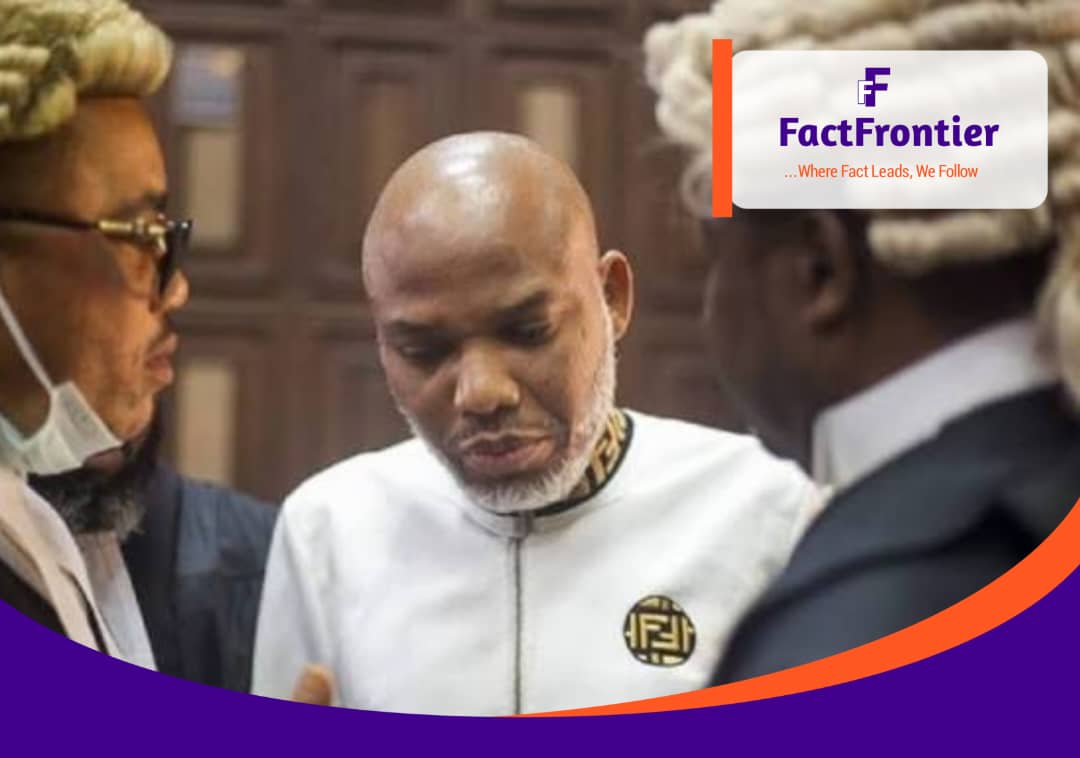
In a landmark ruling that marks a critical juncture in one of Nigeria's most high-profile and protracted legal battles, the Federal High Court in Abuja has convicted Nnamdi Kanu, the leader of the Indigenous People of Biafra (IPOB), on multiple counts of terrorism and treason. The verdict, delivered on Thursday, November 20, 2025, by Justice James Omotosho, concludes the trial phase of a case that has inflamed tensions and drawn international attention to Nigeria's southeastern regions.
The courtroom atmosphere was charged even before the judgment was read. Kanu, who had chosen to represent himself after dismissing his legal team, was ordered to be removed from the proceedings due to what the judge described as "unruly" behavior. This disruptive end to his presence in the courtroom underscored the defiant stance he has maintained throughout the trial.
The Charges and The Court's Findings
Justice Omotosho found the prosecution's case compelling, ruling that they had successfully proven the seven terrorism-related charges against the IPOB leader. The core of the conviction rests on the assertion that Kanu used his influential platform to incite violence.

The judge stated that Kanu's intention
was quite clear, as he believed in violence. These threats of violence were nothing but terrorist acts.This finding directly addresses the prosecution's argument that Kanu's broadcasts on his London-based Radio Biafra were not merely secessionist rhetoric but explicit calls to action that led to real-world attacks. Specific charges cited his broadcasts that ordered the destruction of the American Embassy and British High Commission, leading the court to formally declare him an "international terrorist."
During the trial, Kanu mounted a vigorous defense, challenging the very foundation of the charges against him. He argued that the Terrorism Prevention and Prohibition Act used by the prosecution had been repealed, rendering the charges invalid. Furthermore, he and his previous legal team have long contended that his extraordinary rendition from Kenya in 2021 was illegal and fundamentally compromised the possibility of a fair trial. The court, however, overruled these objections, paving the way for today's conviction.
A Long and Contested Legal History
Today's verdict is the latest chapter in a legal saga that has stretched for nearly a decade. Nnamdi Kanu, who leads the group seeking independence for a part of southeastern Nigeria to form the Republic of Biafra, was first arrested in 2015. He jumped bail in 2017 under controversial circumstances, fleeing the country, only to be detained and extradited from Kenya in 2021—a move that has been criticized by foreign courts and human rights organizations.
The shadow of the original Biafra secession attempt, which triggered a devastating three-year civil war from 1967 to 1970 that killed over a million people, looms large over this case. The Nigerian government has consistently viewed IPOB's activities as a major threat to national sovereignty and security. The prosecution's case heavily relied on drawing a direct line between Kanu's inflammatory broadcasts and a surge of violence in the southeastern states, which authorities have linked to hundreds of deaths among security personnel and civilians.
The Awaiting Sentence and Its Implications
Following the conviction, the court went into a recess and is scheduled to reconvene to deliver the sentence. The prosecution has not minced words about the punishment they seek, having formally requested the death penalty for the IPOB leader. They argue that the laws under which he was convicted carry that maximum sentence.
The impending sentencing has placed the nation on high alert. Supporters of Kanu and the Biafra cause have historically protested court decisions, and there are significant concerns that the final judgment could trigger widespread civil unrest in the already volatile southeast. Conversely, many who hold the Nigerian state as indivisible see the conviction as a long-overdue measure of justice against a figure they accuse of sowing chaos and division.
As Nigeria awaits the final act in this courtroom drama, the sentencing of Nnamdi Kanu is set to be a pivotal moment with profound implications for the country's unity, its approach to separatist movements, and the delicate balance between national security and freedom of expression. The world watches to see how the judiciary will conclude a case that has become a symbol of the nation's most deep-seated historical and political tensions.


