



By Abdulahmeed Abdulrozaq Bilal | Fact Frontier.
Click here to read more about the reporter.
In a significant and sudden military intervention, the United States conducted a series of airstrikes against ISIS targets in northwestern Nigeria on the evening of December 25, 2025. The operation, confirmed by both U.S. and Nigerian authorities, represents a notable escalation of direct U.S. counterterrorism action in West Africa and has sparked a complex dialogue about sovereignty, security, and the framing of regional conflicts.
The Christmas Day Operation
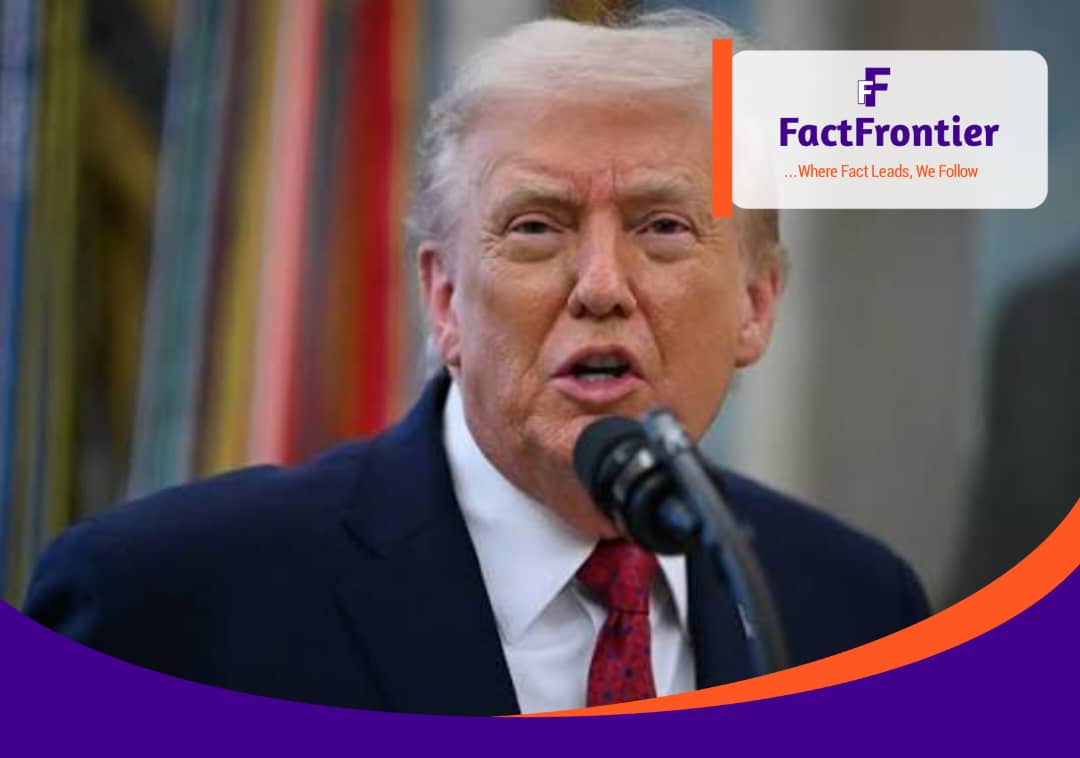
According to official statements, the "precision" strikes were carried out in Sokoto State, near Nigeria's border with Niger. U.S. President Donald Trump announced the action on his Truth Social platform, stating
the military had executed powerful and deadly airstrikes against ISIS terrorists responsible for targeting Christians.He characterized the group's actions as part of an "existential threat" and "genocide," framing the U.S. response as a direct counter to religious persecution.
The U.S. Africa Command (AFRICOM) provided tactical details, confirming the strikes targeted an ISIS-linked camp and resulted in the death of "multiple ISIS terrorists." Crucially, they emphasized the operation was conducted "with the approval and at the request of Nigerian authorities," a point corroborated by Nigeria's government.

Nigerian Government's Confirmation and Nuanced Stance
The Nigerian Ministry of Foreign Affairs issued a statement confirming the event, noting the "precision hits on terrorist targets" were part of existing security partnerships. However, Nigeria's narrative diverged subtly from the U.S. framing. While acknowledging the strike, the government has long maintained that violence from insurgent groups is a "complex security challenge" affecting all communities, not a singular religious conflict. A government spokesperson reiterated in December that terrorist attacks on
any Nigerian community, whether Christian or Muslim, is an affront to our national unity and values.
This distinction highlights a central tension: the U.S. justification leans heavily on a religious persecution narrative, while the Nigerian state, facing a multifaceted insurgency across its northern regions, views the issue through a lens of national security and territorial integrity.
Geopolitical Context and Immediate Implications
The December 25 strikes did not occur in a vacuum. They are a direct escalation of U.S. policy in the region. For years, the U.S. role has primarily been one of training, intelligence sharing, and limited drone surveillance. A kinetic airstrike of this scale inside Nigeria, a sovereign and militarily capable regional power, marks a sharp departure.
The target itself is also of strategic significance. The ISIS affiliate in West Africa (ISWAP), which broke from Boko Haram, has established a stronger foothold in recent years, particularly in the Lake Chad basin and northwestern regions like Sokoto. The group has been responsible for complex attacks on military and civilian targets. A successful, high-profile U.S. strike directly degrades their operational capacity and projects U.S. reach.
Reactions and Strategic Calculations
Regional security analysts observed that the operation serves multiple purposes. For the U.S., it is a demonstrative act of force following President Trump's strong rhetoric on Christian persecution. It signals a willingness to employ military power unilaterally, even in complex allied territories, to address threats framed in civilizational terms.
For Nigeria, the cooperation presents a double-edged sword. It provides immediate tactical relief against a potent enemy and demonstrates international security partnership. However, it also risks the perception of ceding sovereign counterterrorism space to a foreign power, a sensitive issue domestically. The careful wording of Nigeria's confirmation statement appears designed to assert national ownership of the action and its context.


