



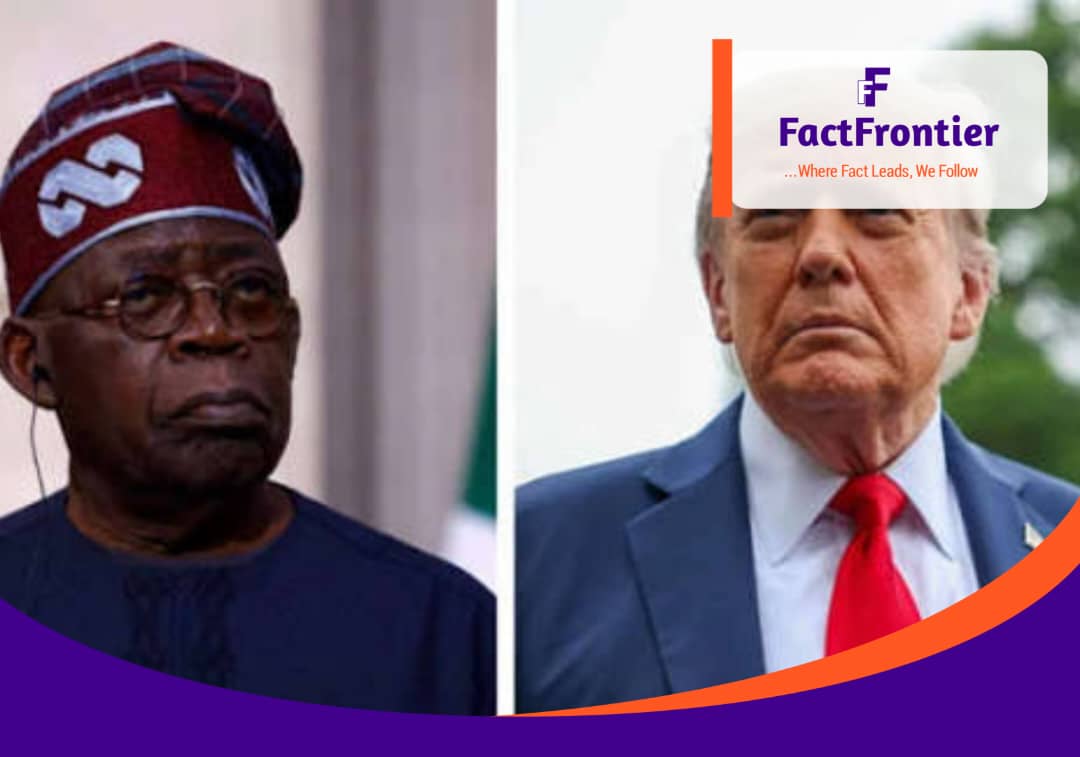
By Festus Damilare Ukolo | Fact Frontier.
Click here to read more about the reporter.
You might have seen alarming headlines suggesting Nigeria paid off a U.S. president to stop an invasion. The reality is less Hollywood but arguably more revealing of modern geopolitics: it's a story about high-priced lobbyists, diplomatic panic, and a nation fighting for its image on the world's most influential stage.
The Contract: What Actually Happened
In December 2025, the administration of Nigerian President Bola Tinubu quietly authorized a $9 million contract with a Washington, D.C. firm called the DCI Group. This wasn't a shadowy backroom deal but a filing under the U.S. Foreign Agents Registration Act (FARA), a law designed to bring transparency to foreign lobbying.
The deal, as detailed in the FARA filing, is structured in two parts: an initial $4.5 million payment made on December 12, 2025, and a second $4.5 million installment due in July 2026. The agreement automatically renews for another year unless Nigeria cancels it with 60 days' notice. So, yes, another multi-million dollar payment is on the calendar for this summer, pending any changes.

The "Why": More Than Just Talking Points
Read also:
• China fired back at the U.S over plan to overtake Greenland.
On paper, the contract has two clear objectives. DCI Group is tasked with helping Nigeria
communicate its efforts to protect Christian communitiesand
maintain U.S. support for countering West African jihadist groups,according to the firm's disclosure. These are direct responses to acute pressure from the Trump administration, which in October 2025 redesignated Nigeria as a "Country of Particular Concern" primarily over issues of religious freedom.
However, viewing this solely as a public relations effort misses the broader, more urgent context. This lobbying push is a damage control operation triggered by a series of escalating events. The relationship hit a potential point of no return in late December 2025, when a U.S. airstrike targeted jihadist militants in Nigeria's Sokoto State—a stark demonstration of unilateral American action on Nigerian soil. Reports, including one from The Africa Report which first detailed the contract, suggest the Tinubu government felt it was facing a "perfect storm" of diplomatic and military pressure.
Furthermore, Nigeria isn't just lobbying to improve its image; it's actively fighting a narrative war. Simultaneously, pro-Biafran separatist groups have been campaigning in Washington, seeking U.S. support for independence and sanctions against the Nigerian government. Tinubu's massive contract with DCI, a firm with deep ties to the Republican Party, is a countermeasure to ensure Nigeria's voice isn't drowned out by its detractors.
The Domino Effect: Domestic Backlash and Strategic Calculations
Back home in Nigeria, the revelation of the $9 million spend has ignited a firestorm of criticism. Opposition figures and citizens alike are questioning the necessity of such a colossal payout to American consultants amidst severe economic hardships at home.
It's a scandalous waste of scarce resources,one opposition senator labeled it, capturing a widespread sentiment of frustration.
For President Tinubu, however, the calculus is likely one of political survival. With the 2027 elections on the horizon, the stakes couldn't be higher. A major diplomatic rift with the United States, coupled with potential further sanctions or military strikes, could devastate the Nigerian economy and political stability. In this light, the $9 million is framed by supporters not as an expense, but as a strategic investment to safeguard billions in aid, security cooperation, and international standing.
The Bigger Picture: Lobbying as Foreign Policy
This episode underscores an uncomfortable truth in 21st-century statecraft: access in Washington is a premium commodity. For nations under scrutiny, hiring well-connected insiders isn't just about communication; it's about crisis management and securing a seat at the table where decisions affecting their sovereignty are made. The DCI Group, by virtue of its Republican links, is seen as a conduit to the very administration that is applying the pressure.
So, while no suitcase of cash was handed over to avert tanks, Nigeria has embarked on a legally documented, immensely expensive journey to reshape its story in America. The July 2026 payment will be a bellwether—if it proceeds, it signals Nigeria's belief that this high-priced advocacy remains its best shield in a turbulent and unpredictable relationship. The success or failure of this $9 million gamble will be measured not in headlines, but in the silent calculus of sanctions not imposed, strikes not ordered, and a diplomatic channel that remains, however tensely, open.


