

By Abdulahmeed Abdulrozaq Bilal | Fact Frontier.
Click here to read more about the reporter.
The relationship between the Nigerian citizen and the police officer at the checkpoint has long been defined by an asymmetric imbalance of power. For decades, the passenger’s primary strategy has been passive compliance, often coupled with the quiet despair of extortion. However, a recent judicial intervention and the codification of the Nigeria Police Act 2020 are recalibrating this dynamic. The most potent tool now available to the Nigerian passenger is not a connection in high places, but a smartphone camera and a precise knowledge of the law.
The cornerstone of this new reality was laid in March 2026 by the Federal High Court in Warri, Delta State. In a landmark judgment delivered by Justice Hyeladzira Nganjiwa (Suit No. FHC/WR/CS/87/2025), the court issued a definitive affirmation that citizens possess the constitutional right to record police officers in the discharge of their public duties. The ruling, which awarded ₦5 million in damages against police infringement of this right, declared unequivocally that it is unlawful for any officer to harass, intimidate, arrest, or seize recording devices from a citizen documenting a stop-and-search operation.
This judicial pronouncement is grounded firmly in Section 39 of the 1999 Constitution of the Federal Republic of Nigeria, which guarantees the right to freedom of expression. It serves as a necessary counterweight to the persistent culture of impunity observed on Nigerian roads.

The Legal Framework for the Passenger
Beyond the right to record, the Nigeria Police Act 2020 provides a structured framework for passenger protection that is too often ignored in practice. The Act stipulates that a stop-and-search operation cannot be arbitrary; it must be predicated on a "reasonable suspicion" grounded in specific facts. Furthermore, an officer is required to be in full uniform or visibly display a valid identification card. The court’s ruling further reinforced the necessity for officers to wear legible name tags and display force numbers, thereby removing the veil of anonymity that often emboldens misconduct.
Passengers must also be aware of the constitutional safeguards concerning detention. Section 35 of the 1999 Constitution mandates that any person arrested be brought before a court of law within a reasonable time—defined as 24 hours, or 48 hours where a court is not within a 40-kilometer radius. The detention of a citizen for hours over spurious document checks or, more commonly, as a bargaining chip for a bribe, remains a flagrant violation of this provision.
The Persistence of Misconduct
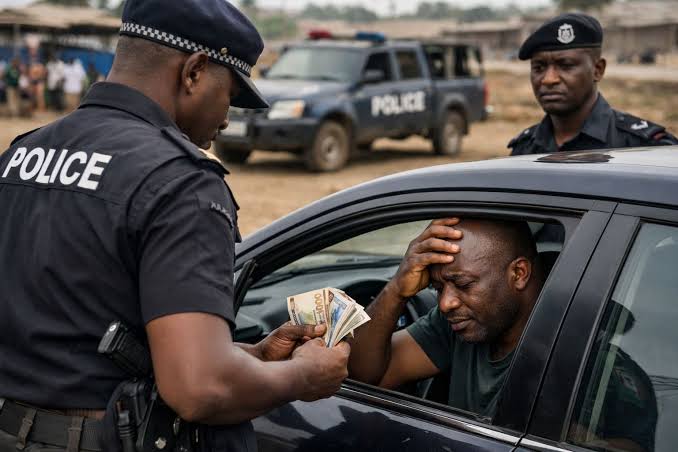
Despite these clear legal protections, the gulf between statute and street-level reality remains vast. Recent reports continue to highlight a pattern of predatory behavior. In one incident in Anambra State (March 2026), six officers were detained for allegedly extorting ₦200,000 from a driver whose papers were in perfect order. The victim was handcuffed and isolated until a PoS transfer was completed. Similarly, in Edo State, an officer was filmed demanding fuel and cash from motorists under the guise of suspended road safety enforcement.
These are not isolated aberrations but symptoms of a systemic failure in oversight and remuneration that transforms the public highway into a revenue-generating stream for unscrupulous personnel.
Avenues for Recourse The effectiveness of these rights depends entirely on the citizen's willingness to pursue recourse. The Nigeria Police Force maintains a Complaint Response Unit (CRU) reachable via 09133333785 or WhatsApp at 08057000003. Additionally, the Police Service Commission (PSC) offers a Compliance Monitoring Unit for escalated cases of abuse.
The Warri judgment is more than a legal victory; it is a policy directive. It signals that the era of silent suffering at checkpoints must end. An informed citizenry, armed with the twin protections of the Constitution and the camera lens, remains the most effective guarantor of police accountability. The onus is now on the police hierarchy to ensure that this right is not merely a footnote in a law report, but the lived reality of every Nigerian road user.