
By Festus Damilare Ukolo | Fact Frontier.
Click here to read more about the reporter.
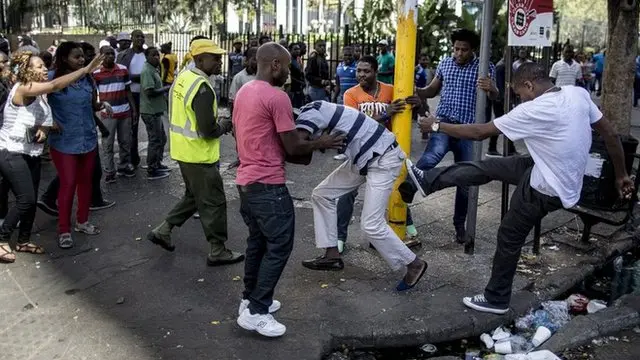
As xenophobic attacks tear through hotspots in Gauteng, KwaZulu-Natal, and the Eastern Cape, a deeper analysis reveals the bloodshed is neither spontaneous nor purely economic. Mounting evidence points to a deliberate political strategy where migrants are being weaponized as scapegoats ahead of the fiercely contested November 2026 local government elections.
The core political logic is drenched in expediency. With an unemployment rate stubbornly stuck above 30% and widespread frustration over failing public services, a growing chorus of political figures has found it far easier to blame vulnerable foreign nationals than to fix systemic decay. This scapegoating transforms complex socioeconomic failures into an us-versus-them narrative, allowing politicians to present themselves as defenders of neglected citizens. The result is a public discourse in which migrants are falsely branded the chief cause of crime, joblessness, and even healthcare collapse, creating a permissive environment for violence.
Election timing has turned this rhetoric into a lethal accelerant. Analysts warn the current surge is a direct echo of previous electoral cycles where xenophobic hostility spiked. With the November 2026 local polls looming, anti-immigrant posturing has become a potent mobilization tool. ActionSA leader Herman Mashaba has publicly declared that any party seeking a post-election coalition with him must endorse mass deportations of undocumented foreigners, describing the demand as a “non-negotiable” red line. While he frames it as a jobs-and-safety crusade, opponents have swiftly condemned it as “xenophobic electioneering,” and Mashaba’s participation in anti-immigrant marches alongside hardline groups has cemented the link between campaigning and communal unrest.

Crucially, xenophobic politics is no longer confined to the fringe. It is being sanitized and mainstreamed through a deliberate language shift. Instead of racial slurs, organizers and sympathizers now deploy clinical terms like “illegal alien” and “undocumented immigrant” to lend a veneer of respectability to exclusionary policies. This linguistic rebranding makes it easier for mainstream parties to flirt with xenophobic ideas as a “governance concern.” Parliamentary maneuvers reflect the same trend; for instance, the Democratic Alliance accused the Gauteng ANC government of attempting to pass a Township Economy Bill that would “drive foreign nationals out of townships,” an approach the DA said was “reminiscent of apartheid spatial planning” and fundamentally xenophobic.
This political project is also powered by a dangerous nexus between elected leaders and vigilante organizations. Groups like Operation Dudula, which a court has interdicted for intimidation, harassment, and hate speech, no longer operate in the shadows. They march openly alongside political parties including the Patriotic Alliance and ActionSA, with leaders justifying their presence as filling a “vacuum” left by a government “too slow to act” on migration. This cooperation lends political legitimacy to vigilante actions—ranging from storming schools to shuttering foreign-owned shops—while providing politicians with grassroots foot soldiers to energize their base.
What ignited the Eastern Cape city of East London was not simply economic anxiety but a cultural-political spark: a contested claim that a “Nigerian king” was being installed in the area. The episode, amplified by local actors, shows how quickly identity politics can set communities ablaze when a receptive political infrastructure is already in place.
In essence, the xenophobic violence racking South Africa is not a tragic by-product of hardship alone. It is a manufactured crisis, designed and deployed by political actors who profit from division. Unless that connection is severed, every election season will bring fresh calls for deportations, fresh justifications for vigilantes, and fresh graves of those who were turned into political props.